

Managing energy performance across a diverse property portfolio is a complex and demanding task. Property owners and asset managers face mounting regulatory pressure to meet stringent energy efficiency targets. This requires much more than just collecting Energy Performance Certificates (EPCs) to tick a compliance box.
To future-proof a portfolio, estate managers need a strategic understanding of how to improve their assets efficiently. They need clear data to justify capital expenditure and drive meaningful sustainability improvements.
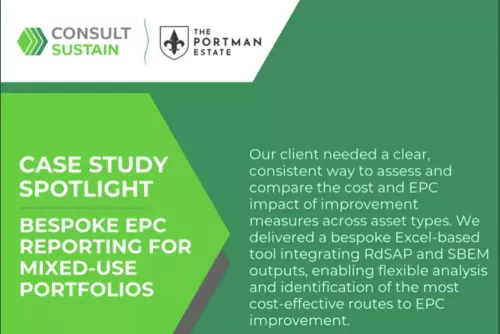
Recently, following a welcome introduction from Norman Bromley Partnership LLP, Consult Group supported The Portman Estate with a unique energy reporting challenge. We developed a bespoke EPC reporting solution across their extensive residential and commercial portfolio. This case study explores how we transformed standard compliance data into practical, decision-ready investment insight.
The Challenge of Mixed-Use Portfolios
Reviewing EPC performance across a mixed-use portfolio presents a distinct set of operational challenges. Residential and commercial properties do not use the same energy assessment methodologies. This creates an immediate hurdle when trying to establish a unified view of an estate's environmental impact.
Residential assets rely on the Reduced Data Standard Assessment Procedure (RdSAP). This system evaluates domestic properties based on standard occupancy patterns and typical energy use. Conversely, commercial assets use the Simplified Building Energy Model (SBEM). This model calculates the energy used by lighting, heating, and ventilation in non-domestic buildings.
These two systems produce fundamentally different data outputs. When an estate manager tries to view their entire portfolio's performance, these differing data sets create a fragmented and confusing picture. Comparing the potential impact of an insulation upgrade in a residential flat against a new HVAC system in a commercial office becomes incredibly difficult without a unified framework.
Moving Beyond Basic Compliance
For many years, the property sector treated EPCs simply as a legal necessity for renting or selling a building. However, tightening minimum energy efficiency standards (MEES) have changed the landscape entirely. An EPC is now a critical indicator of an asset's viability, desirability, and future value.
The Portman Estate recognised the need to move beyond basic compliance reporting. They wanted a strategic overview of their buildings. The requirement was to clearly review the individual and combined impact of various energy improvement measures.
They needed a system that enabled an informed comparison of cost versus EPC benefit across completely different asset types. Without this clarity, capital investment in sustainability risks being poorly targeted and financially inefficient.
Developing a Custom EPC Reporting Tool
To solve this complex data problem, Consult Group developed a custom, Excel-based reporting tool tailored specifically to The Portman Estate’s requirements. We knew that an off-the-shelf software package would not provide the nuanced, cross-portfolio comparison the client needed.
Our team worked meticulously to integrate the diverse outputs from both RdSAP and SBEM assessments into a single, cohesive dashboard. This required a deep technical understanding of how both energy models calculate performance metrics. We built a framework that translates these different metrics into a common language for asset managers.
This bespoke tool provides clear, flexible analysis of the entire property portfolio. Users can manipulate the data to model different upgrade scenarios. They can instantly see how specific interventions will alter the EPC rating of an individual unit or an entire block.
Bridging the Data Divide
The true value of this reporting tool lies in its ability to bridge the gap between technical energy data and commercial investment strategy. It allows the estate management team to input the estimated costs of various improvement measures, such as solar panel installation, window upgrades, or boiler replacements.
The tool then calculates the projected uplift in the EPC score against the capital cost. This functionality identifies the most cost-effective routes to EPC improvement across the portfolio. It highlights 'quick wins' where minor investments yield significant rating improvements, alongside long-term capital planning requirements.
By standardising the data from mixed-use assets, the tool removes the guesswork from sustainability investments. It empowers the client to direct their budgets toward the measures that deliver the best return on investment and the greatest carbon reduction.
Transforming Data into Investment Insight
A strong reporting tool must ultimately drive better business decisions. The bespoke solution we delivered for The Portman Estate stands as a prime example of how tailored reporting transforms static compliance data into practical investment insight.
Instead of dealing with hundreds of isolated PDF certificates, the estate team now has a dynamic, data-driven overview of their assets. They can proactively plan their maintenance and refurbishment cycles with energy efficiency at the forefront of the agenda. This proactive approach is essential for mitigating the risk of stranded assets in a rapidly evolving regulatory environment.
Furthermore, this level of detailed reporting supports broader Environmental, Social, and Governance (ESG) objectives. It provides a transparent, auditable trail of how the estate is actively working to decarbonise its built environment. This transparency is increasingly vital for stakeholders, investors, and environmentally conscious tenants.
The Future of Property Sustainability
The built environment is responsible for a significant proportion of global carbon emissions. Decarbonising our existing building stock is one of the most critical challenges facing the property sector over the next decade. Achieving this requires intelligent data management and highly targeted investment strategies.
As energy regulations continue to tighten, the value of bespoke, accurate reporting will only increase. Property owners can no longer afford to treat residential and commercial energy data in isolation. They need holistic solutions that provide a comprehensive view of their environmental impact and their pathway to net zero.
Our work with The Portman Estate demonstrates that complex portfolio data can be simplified and harnessed effectively. By embracing tailored reporting tools, property owners can turn the challenge of energy compliance into a strategic commercial advantage.
Take the Next Step with Your Portfolio
Are you currently managing a diverse property portfolio and struggling to make sense of fragmented energy data? Understanding your baseline performance is the first vital step toward meaningful decarbonisation and asset protection.
If you are reviewing EPC performance across a mixed-use portfolio and would value clearer, decision-ready insight, our expert team is here to help. We understand the technical complexities of both RdSAP and SBEM models, and we know how to translate that data into commercial strategy.
We would be delighted to share our approach with you and discuss how a bespoke reporting solution could benefit your estate. Get in touch with Consult Group today to discover how we can help you navigate the future of property sustainability.